Showing posts with label audi. Show all posts

The new ABT Q3 - Kempten commitment to maximum urban sportiness

|

Thursday, August 11, 2011


2012 ABT Q3

“The Q3 is an extremely athletic yet very elegant vehicle. It combines the powerful aesthetics of a robust car with the shape of a cool coupe”, explains Hans-Jürgen Abt. For the CEO of ABT Sportsline, the world’s largest tuner of vehicles from the VW Group, the latest offspring of the SUV family represents an absolute highlight in the product range: “In its class the Q3 is something special. For our designers it provides the perfect working basis, as it is both classy and dynamic”, states Hans-Jürgen Abt. For example the Abts were able to further accentuate the unique tornado curves of the Q3 with side sills. In connection with the striking ABT front grill and the front spoiler the inherently compact car seems more powerful and to have more presence. The rear wing, rear apron and exhaust pipe covers ensure that from the rear of the SUV you can see that the car has a good figure.


After all the ABT Q3 does not just look sporty – it is sporty too: the engineers from Bavaria are currently working on the final tests of the individual ABT POWER performance packages. But it is already certain that the new car will provide an additional boost of maximum sportiness and extra driving enjoyment in practically all situations. As a result the most powerful version of the 2.0 TSI is expected to offer 250 HP or 184 kW (series standard: 211 HP/155 kW). The 170 HP version (125 kW) has been converted by ABT Sportsline into a sports engine with 210 HP (154 kW). For SUVs, a diesel engine is of course always a good, economical solution. As a result ABT POWER is also available for both performance levels of the economic 2.0 TDI: the series standard 140 HP (103 kW) is increased to 170 HP (125 kW), while the version with 177 HP (130 kW) as standard offers a high-torque 195 HP (143 kW) after the power treatment by ABT. The turbo diesel with two litre cubic capacity is the first choice if you want a little more, for example if the athletic ABT Q3 is also to be used as a workhorse.

Regardless of which engine is chosen, the customer always receives a vehicle which combines maximum driving fun with everyday usability and reliability. The fact that handling and optics do not have to suffer due to the car’s diversity is proved emphatically by the SUV of ABT. And the new Q3 in particular is a really attractive car, its design elements harmonise with the performance improvements – both have been developed as it were from the high demands of ABT customers. Consequently the extravagant light metal alloys from the CR and DR ranges suit the ABT Q3’s powerful-robust coupe shape perfectly. It goes without saying that the alloys are also available in combination with strong load-bearing high-performance tyres – in accordance with the commitment to maximum urban sportiness.

The new ABT Q3 – data and facts

ABT engine technology
  • Engine : 2.0 TDI, 1.968 ccm capacity
  • Performance tuning : ABT POWER
  • Performance : 170 HP/125 kW (standard: 140 HP/103 kW)
ABT engine technology
  • Engine : 2.0 TDI, 1.968 ccm capacity
  • Performance tuning : ABT POWER
  • Performance : 195 HP/143 kW (standard: 177 HP/130 kW)
ABT engine technology
  • Engine : 2.0 TSI, 1.984 ccm capacity
  • Performance tuning : ABT POWER
  • Performance : 210 HP/154 kW (standard: 170 HP/125 kW)
ABT engine technology
  • Engine : 2.0 TSI, 1.984 ccm capacity
  • Performance tuning : ABT POWER
  • Performance : 250 HP/184 kW (standard: 211 HP/155 kW)
ABT aerodynamics
  • ABT front grill
  • ABT front skirt
  • ABT door strip attachments
  • ABT rear skirt set with exhaust inserts
  • ABT rear wing
ABT suspension
  • ABT suspension springs
ABT wheel technology
  • ABT CR and DR designer light alloy wheels in 18 to 20 inch
  • Available also as complete set of wheels with sports tyres

[Source : ABT Sportline]

The Audi urban concept – a completely new kind of concept car

|

Wednesday, August 10, 2011


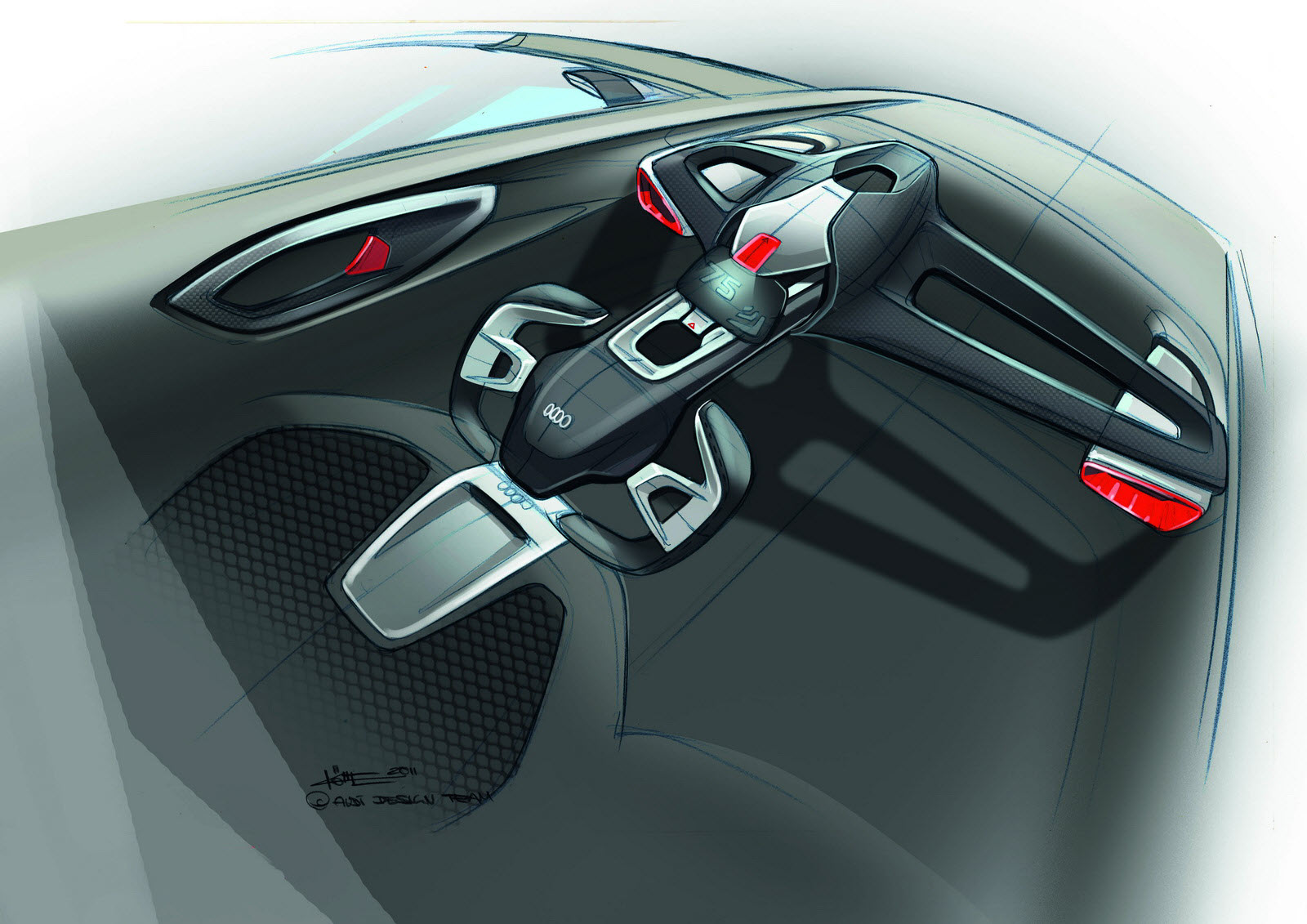
Audi Urban Concept

  • An innovative urban concept car with 1+1 seats
  • Sleek cockpit made from CFRP, free-standing wheels with protective plates
  • Elaborate suspension, compact electric drive system for sporty performance
INGOLSTADT : August 10, 2011 - Audi is once again opening up new horizons: the Audi urban concept is a 1+1-seat, ultra-light car for congested urban spaces. The technical study does not fit under any of the conventional categories – the Audi urban concept combines elements of a racing car, a fun car and an urban car into one radical new concept.


The Audi urban concept is not based on any previous model – its development is solely oriented on the strict principles of lightweight construction, efficiency and reduction. The result is a concept car with no unnecessary weight, and one that concentrates on the pure essence of sporty motion.

The Audi urban concept has a sleek body. The wheels are free-standing, their surrounding protective plates feature blinking strips of LED lights. The highly concentrated look of the technical study, with its forward-urging lines, is dynamic and emotional – it lends Audi’s design language a completely new impetus.

On board there is room for two people, their position slightly staggered and at a sporty, low level. All controls and materials are subject to the dictates of ultra-lightweight construction in order to ensure they convey a completely unique, sensory allure. The driver can adjust the steering wheel and pedals to his own body measurements. Entry to the car is via the tailgate. The roof is designed to be maneuverable and slides to the rear to open.

The technology in the Audi urban concept reflects the full capabilities of the brand, especially when it comes to ultra-lightweight construction. The cockpit consists of carbon fiber-reinforced polymer, which integrates the undercarriage of both seats. The Audi urban concept rolls on wheels with a 21-inch diameter.

Two e-tron electric motors provide the propulsion – providing the ultra-light Audi urban concept with the ability to accelerate powerfully. A lithium-ion battery supplies the energy – ideal for extended city tours.

Images : Audi Urban Concept


[Source : AUDI]

Audi updates A5 with the new 1.8 TFSI engine

|

Thursday, August 4, 2011


2012 AUDI A5

  • Ample power and minimal consumption: 125 kW (170 hp) and 320 Nm (236.02 lb-ft) torque, but just 5.7 liters per 100 km (41.27 US mpg)
  • New solutions in fuel injection and other fields of technology
  • Fully electronic coolant regulation system
INGOLSTADT : August 4, 2011 - The engines in the updated A5 family set new standards for sportiness and efficiency. Even the base engine, the completely redesigned 1.8 TFSI, showcases the full extent of Audi’s technological competence. The engineers have developed innovative solutions in numerous fields of technology to achieve surprisingly strong performance with minimal fuel consumption.


2012 Audi 1.8 TFSI Engine

The high-end four-cylinder engine displaces 1,798 cm3 and delivers a brawny and constant 320 Nm (236.02 lb-ft) to the crankshaft between 1,400 and 3,700 rpm. Peak output of 125 kW (170 hp) is achieved at 3,800 rpm. With a manual transmission, the 1.8 TFSI accelerates the Audi A5 Coupé from zero to 100 km/h (62.14 mph) in 7.9 seconds on its way to a top speed of 230 km/h (142.92 mph). Despite all this power, it consumes just 5.7 liters of fuel per 100 km (41.27 US mpg) on average, which corresponds to best-in-segment emissions of 134 grams of CO2/km (215.65 g/mile). Consumption has been reduced by 21 percent compared with the previous model engine.

Combustion behavior was a particular focus of the development work. In addition to FSI direct injection, the 1.8 TFSI also uses indirect injection. This system injects the fuel at the end of the intake manifold near the tumble valves, where it is swirled intensively with the air. Indirect injection is used in the part-load range. It reduces fuel consumption and particulate emissions to such an extent that the four-cylinder engine already complies with the limits of the future Euro 6 standard, which does not enter into force until 2015.

The rail pressure of the FSI system has been increased from 150 to 200 bar. The direct injection system is active when starting off and at higher loads. It can perform two or three individual injection operations per work cycle. To further optimize gas exchange, the valve control system has been given greater operating freedom. The Audi valvelift system, which adjusts the lift of the valves in two stages, is active on the exhaust side. The two camshafts can be adjusted through 30 or 60 degrees of crankshaft angle.

Fully electronic coolant regulation system

The innovative thermal management of the four-cylinder engine features a new fully electronic coolant regulation system. Two fast-switching, rotating cores, which are consolidated in a module and driven by an electric motor via a screw drive, control the flow of coolant. One of their primary objectives is to bring the motor oil up to operating temperature as quickly as possible following a cold start. This is done by keeping the coolant in the crankcase for a relatively long time. The cabin heating runs off of a separate loop in the cylinder head. The main radiator, which dissipates the heat to the environment, does not come into play until the latest possible moment.

The new rotating core module can set the water temperature between 85 and 107 degrees Celsius as a function of load and rpm to always achieve the best compromise between minimal internal friction and thermodynamic efficiency. Switchable valves throughout the cooling system manage heat flows between the engine, the heat exchanger for the transmission and the cabin. All together, the thermal management system reduces the CO2 emissions of the 1.8 TFSI by around 2.5 g per 100 km (4.02 g/mile).

This concept benefited from the integration of the exhaust manifold into the water-cooled cylinder head. Because this also reduces the exhaust gas temperature, it is not necessary with the 1.8 TFSI to enrich the mixture at full load, which reduces fuel consumption significantly when driving sportily.

The turbocharger in the 1.8 TFSI is also an all-new design that develops the high relative boost pressure of up to 1.3 bar very systematically. Key features include a turbine wheel made from a new alloy that can withstand exhaust temperatures of up to 980 degrees Celsius, the oxygen sensor mounted directly upstream of the turbine wheel, a pulsation damper, a compressor wheel machined from a solid blank and an electric wastegate actuator that adjusts the boost pressure particularly quickly and precisely to further reduce fuel consumption.

Engine weight has been reduced from 135 to 131.5 kilograms (297.62 to 289.91 lb). The new turbocharger/cylinder head module, a new casting process for the gray cast iron crankcase that reduces wall thickness to roughly three millimeters (0.12 in) and the crankshaft with four rather than eight counterweights and reduced main bearing diameters all contributed to this weight reduction. The pistons are made of new, high-strength alloy. Lightweight polymers are used for the oil pan, and many screws are made of aluminum.

Internal friction has also been drastically reduced by the use of an innovative coating on the piston skirts and by mounting the two balance shafts that counteract the second-order inertial forces in roller bearings. The regulated oil pump requires little energy itself, and the oil-jet cooling for the piston heads is controlled via a high-precision electric system.

[Source : AUDI]

MTM A7 3,0 TDI Quattro - a little bit more power?

|

Monday, August 1, 2011


2011 MTM A7 3.0 TDi Quattro

Diesel engines prefer to show their strong sides in the part-load operational range: here they have a good traction and consume a little. This is also true for the A7 TDI Quattro which offers 245 hp and a tight torque of 500 Nm. For the typical MTM customer it can even be more in this 3 litre compression-ignition engine. Roland Mayer, head of MTM and the driving force behind this engineering laboratory outside the gates of Ingolstadt, learned about the original virtues of Audi six-cylinder cars, cultivated them partially and prepared two more variations, which leave nothing to be desired:


285 hp and 580Nm or 300 hp and 600Nm. This operation proceeds minimal inversive in both cases and is settled after 90 minutes. For the moderate version MTM focuses on the approved M-Cantronic. In business class MTM modifies the control unit. This heads the shapely A7 to a highspeed of 263 km/h. Both systems are available for 1.392 Euro incl. fitting.

Around 2.600 Euro – inclusive fitting – the perfectly adjusted exhaust system with four 89mm tail pipes costs. This is a visible sign that a MTM diesel is expected rather on the fast lane than on the slow lane.


This is not enough. More performance often requests the wish of a better handling. A suspension system for the A7 TDI Quattro is already tested and will soon be available for active operation. The MTM 20 inch rims in the Bimoto design in combination with 20mm or 30mm wheel spacers are also a part of the MTM product range. ‘The package is not yet calculated but I think that the suspension system will be available at a price of 699,- Euro’ says Roland Mayer. The earliest delivery date will be end of August 2011.

Images : 2011 MTM A7 3.0 TDi Quattro


[SOurce : MTM]

Audi R8 LMS wins 24-Hour race at Spa-Francorchamps

|

Sunday, July 31, 2011


24-hour Spa-Francorchamps winners : Matthias Ekström / Greg Franchi / Timo Scheider - #33 Audi R8 LMS - Audi Sport Team WRT

INGOLSTADT/SPA : July 31, 2011 – The Audi R8 LMS won the most important endurance race for GT cars ahead of BMW and Mercedes-Benz. Audi Sport Team WRT overcame the strongest competition during the 63rd running of the 24 hours of Spa (Belgium). The two DTM stars Mattias Ekström (Sweden) and Timo Scheider (Germany) and the Belgian endurance specialist Greg Franchi shared driving duties in the victorious mid-engine sportscar.


24-hour Spa-Francorchamps winners : Matthias Ekström / Greg Franchi / Timo Scheider - #33 Audi R8 LMS - Audi Sport Team WRT

Experts agreed before the race started that the endurance classic, held since 1924, had never fielded so many potential winners as this year. A total of 62 cars representing 13 different manufacturers joined the grid, including no less than 57 cars of the worldwide booming GT3 category.

The opening stages of the endurance classic in particular fulfilled expectations. Spectators lining the 7.004 kilometer track and in front of television screens enjoyed tough battles for position, countless overtaking maneuvers, retirements and small and big dramas which are typical for a 24-hour race. The Audi R8 LMS was the fastest car in the field from the very beginning. After just a few hours it was clear that the V10 powered R8 sports cars where the favorites for the victory.

The race of the victorious #33 R8 LMS fielded by Audi Sport Team WRT was particularly impressive. The car driven by Mattias Ekström, Greg Franchi and Timo Scheider ran like clockwork for 24 hours, while many other GT3 cars were no match for the stresses and strains of the hard fought endurance race. The brake discs and pads were changed twice as scheduled. Apart from this, the R8 LMS only entered pit lane to refuel, change tires and to swap drivers. At the start of the tenth hour Ekström/Franchi/Scheider took the lead which they duly held all the way to the checkered flag. At the finish the trio had a two-lap lead over the closest rival.

Audi led 22 of the 24 hours. Just after midnight three R8 LMS actually occupied the first three positions. However, while Audi Sport Team WRT also celebrated fourth overall for the #32 car, Audi Sport Team Phoenix was struck by bad luck.

Marc Basseng, Christopher Haase and Frank Stippler led convincingly for many hours in the #99 R8 LMS and had eked out an advantage of almost an entire lap. Just after 1 a.m. Haase lost first place due to a faulty air jack system. Only an hour later the youngster slid off the track on a damp patch at Turn 9 and had to retire the car.

The #98 sister car was hit by a slower car on the left rear wheel while fighting for the lead towards the end of the third hour. Shortly afterwards second gear was lost. Although they had to continue without second gear as a result and lost additional time due to a puncture, Marcel Fässler, Andrea Piccini and Mike Rockenfeller worked their way back up to third from 13th before a gearbox change was required just after midnight. The change cost 1 hour 36 minutes. The trio still managed to battle their way through the field from 36th to 14th thanks to consistently quick laps and in the process recorded the absolute fastest race lap (Mike Rockenfeller / 2m 20.286s).

The second Audi R8 LMS entered by Audi Sport Team WRT put in two exciting comeback drives. After an accident in qualifying, Stéphane Ortelli scythed spectacularly through the field from 41st to second in the opening 90 minutes, before a drive-through-penalty for contact cost almost a lap. Changing the front left suspension components took 24 minutes and threw the #32 car back to a seemingly hopeless 42nd position. However, Filipe Albuquerque, Bert Longin and Stéphane Ortelli had other ideas, overtook car after car and finished the race in an almost sensational fourth overall. This was the icing on the cake for Audi Sport Team WRT which celebrated an important victory in its first outing as "factory” team for Audi.

"Vincent Vosse’s team really did a fantastic job during its home race,” explained Head of Audi Motorsport Dr. Wolfgang Ullrich. "Mattias (Ekström), Greg (Franchi) and Timo (Scheider) drove fast and without mistakes – and it was exactly this that was the key to victory this weekend alongside the reliability and speed of the R8 LMS. Unfortunately out other three cars were rather unlucky and especially Ernst Moser’s squad. That’s why it was almost like Le Mans at the end: After just a few hours we only had one iron still in the fire – but we won with this car. This shows our strong nerves and team spirit because everybody helped to take the win with the only remaining car.”

The Audi R8 LMS, which is supplied to customers by Audi Sport customer racing since last year, notched up win number 96 this weekend. "After three class victories in the 24-hour race at the Nürburgring and the one-two in the 12-hour race at Bathurst at the start of the year, this is without doubt the most important victory for the Audi R8 LMS and our still relatively young customer racing program,” said Werner Frowein who is responsible for the company’s customer racing program as Managing Director of quattro GmbH. "I’d like to thank everybody who worked so hard and with so much commitment to make this victory possible. After Le Mans, Audi now stands in the winners list of another great 24-hour race. We were able to show that the R8 is a fantastic sportscar. Our increasing number of customer teams also confirms this.”

One of these customer teams, United Autosports, contested the 24 hours Spa with three R8 LMS. Following an eventful race with drivers Richard Dean, Zak Brown, Stefan Johansson and Johnny Herbert can be delighted with 13th overall and sixth place in the Pro-Am category.

2011 Total 24-Hour Spa-Francorchamps : Race result


Pos Car Class Drivers Car Time Laps Gap
1 33 PRO Matthias Ekström / Greg Franchi / Timo Scheider Audi R8 LMS 24:01:22.333 545
2 76 PRO Dirk Werner / Edward Sandström / Claudia Hürtgen BMW Z4 24:02:11.126 543 48.793
3 35 PRO Kenneth Heyer / Thomas Jäger / Stéphane Lemeret Mercedes SLS AMG 24:02:07.328 535 44.995
4 32 PRO Filipe Albuquerqe / Bert Longin / Stephane Ortelli Audi R8 LMS 24:01:22.579 534 0.246
5 29 PRO Matteo Bobbi / Frank Kechele / Giacamo Petrobelli Ferrari 458 Italia 24:02:08.636 531 46.303
6 20 PAM Ludovic Badey / Franck Morel / Guliaume Moreau / Jean-Luc Beaubelique Ferrari 458 Italia 24:02:08.095 530 45.762
7 90 PAM David Jones / Godfrey Jones / Mike Jordan Mercedes SLS AMG 24:02:48.174 529 1:25.841
8 3 PRO Yann Clairay / Julien Rodrigues / Pierre Brice Mena Aston Martin DBRS 9 24:03:03.486 527 1:41.153
9 50 PAM Jack Gerber / Matt Griffin / Nicola Cadei / Marco Cioci Ferrari 458 Italia 24:01:24.005 526 1.672
10 43 PAM Jeroen der Boer / Simon Knap / David Hart BMW Z4 24:02:22.158 521 59.825
11 41 PRO Jonathan Hirschi / Markus Palttala / Antoine Leclerc Ford GT 24:03:36.902 521 2:14.569
12 38 PAM Andril Lebed / Bret Curtis / Peter van der Kolk / Jeroen van der Heuve Mercedes SLS AMG 24:03:54.298 518 2:31.965
13 23 PAM Richard Dean / Zakary Brown / Johnny Herbert / Stefan Johansson Audi R8 LMS 24:01:21.702 512 0.631
14 98 PRO Marcel Fässler / Andrea Piccini / Mike Rockenfeller Audi R8 LMS 24:01:22.799 510 0.466
15 4 PRO Frederic Makowiecki / Henri Moser / Stef Dusseldorp Aston Martin DBRS 9 24:02:22.579 510 1:00.246
16 16 PAM Raf Vanthoor / Marius Ritskes / Bernard van Oranje / Dennis Retera Mercedes SLS AMG 24:03:15.492 504 1:53.159
17 19 GEN Brody / Christoff Corten / Mathijs Herkema / Kurt Dujardin Porsche 997 GT3 Cup S 24:01:48.253 493 25.920
18 124 GEN Martin Rich / Tim Bergmeister / Sebastian Asch / Jochen Krumbach Porsche 997 GT3 Cup S 24:03:26.615 493 2:04.282
19 12 PAM Arie Luyendyk / Alain Li / Richard Meins / Henri Richard Audi R8 LMS 23:34:45.942 490 26:36.391
20 79 PAM Oliver Bryant / Alasdair McCaig / Andrew Smith / Joe Twyman Aston Martin DBRS 9 24:03:49.698 489 2:27.365
21 888 PAM Richard Westbrook / Christian Menzel / Mike Stursberg / Hans Guido Riegel Porsche 997 GT3 R 22:16:18.386 485 1:45:03.94
22 63 GT4 Alex Buncombe / Jordan Tresson / Christopher Ward Nissan 370Z 24:03:19.826 476 1:57.493
23 116 GEN Patrick Chaillet / Thierry de Latre du Bosqueau / Benoit Galand / Christoph Dodge Viper GT3 24:03:59.442 473 2:37.109
24 56 Cup Marc Faggionato / Thierry Stepec / Thierry Prignaud / Franck Racinet Porsche 997 GT3 Cup 23:10:05.068 470 51:17.265
25 60 PAM Adam Christodoulou / Glynn Geddie / Phil Quaife / Roger Wills McLaren GT 24:02:44.783 469 1:22.450
26 82 GEN Domenique Nury / Bernard Salam / Jean-Marc Merlin / Guy Clairay Dodge Viper GT3 24:04:12.854 467 2:50.521
27 100 GT4 Christophe Legrand / Raffaelle Sangiuolo / Guiseppe De Pasquale / Wolfgang BMW M3 GT4 24:02:01.694 465 39.361
28 92 PAM Marc Duez / Jean Michel Martin / Eric Bachelart Ford Mustang FR500 24:03:00.210 444 1:37.877
29 57 Cup Manuel Nicolaids / Fabio Spirgi / Richard Feller / Olivier Baron Porsche 997 GT3 Cup 24:02:13.627 442 51.294
30 85 GEN Benjamin Bailly / Julien Schroyen / Jose Close / Raphael van der Straten Ford Mustang FR500 24:03:00.289 437 1:37.956

Images : Audi Motorsport at 24-hour Spa-Francorchamps


[Source : AUDI]

DTM 2012: Audi banks on A5

|

Friday, July 15, 2011


Audi A5 DTM Concept - Rendered!

  • Two-door coupe to succeed the successful A4 DTM
  • Safety standards even higher than before
  • Presentation at the IAA in Frankfurt
INGOLSTADT : July 15, 2011 – Model change in the DTM: From 2012 on, Audi will bank on the A5 in the most popular international touring car racing series. The coupe, which is internally named "R17,” will replace the four-door A4 DTM with which Audi has won the prestigious DTM title four times since 2004.


The technically and visually upgraded A5 that is will be arriving at dealerships shortly provides the basis for the new DTM car. "In 2012 new Technical Regulations will come into effect in the DTM,” says Head of Audi Motorsport Dr. Wolfgang Ullrich. "We’ve got exactly the right model for that in the A5. We’re convinced that we’ll be able to continue Audi’s success story with it in the DTM.”

The new technical specifications have been worked out by the German Motorsport Association (DMSB) and the DTM umbrella organization ITR in close cooperation with the automobile manufacturers and are setting new standards particularly in terms of safety. "Our engineers have been involved in bringing up safety in the DTM, which had already been high before, to the highest possible level,” explains Dr. Ullrich. "At Le Mans this year we learned again that our concept of designing safety structures is a very good and appropriate one. This is exactly what we’ve been trying to feed into the DTM’s safety concept together with our colleagues from BMW and Mercedes-Benz. This new principle is an outstanding example of what is possible when employees of three premium manufacturers try to achieve a common aim: to get the best possible, lowest-cost and safest vehicle – and a fantastic car in general – off the ground.”


Like all new DTM cars, the new Audi A5 DTM has a high-strength carbon-fiber monocoque that is combined with a steel tube cage. In addition to the A- and C-pillars the new regulations prescribe a B-pillar in front of the driver’s head to be installed in the future. The sidewalls of the vehicles feature a hybrid design with a carbon, Zylon and Rohacell construction that is structurally reinforced by pegs. In case of a side impact the walls have to be able to withstand a static load that is about four times higher than before. "The sidewall has been reinforced so that the new DTM vehicle can be exposed to a side impact (T-bone crash) without the wall failing,” explains Dr. Mühlmeier, Head of Technology at Audi Sport. "Up to now, a bearable side force of 80 kN at a specified point has been required whereas for the 2012-specification vehicles 360 kN across the whole length of the sidewall is now required. This means that the monocoque has not only been reinforced at a certain point but across the entire length.”

The requirements for the front and rear crash absorbers have been increased as well. "At higher speed lower deceleration is specified in order to protect the driver even better than before,” says Dr. Mühlmeier. "To achieve this, a crash test with the whole vehicle is now prescribed for the first time as well – according to FIA standards with 14 meters per second forward and backward against a rigid wall. In the past, ‘only’ the front and rear crash elements had to be driven against a wall with a sled.”

Although fire accidents have almost never occurred in the DTM the safety standard in this respect has been raised even further as well. In the new generation of DTM cars the fuel tank, similar to the Le Mans winning Audi R18 TDI, is integrated into the carbon fiber monocoque. This further reduces the fire hazard in case of a side impact crash.

For Audi the new DTM regulations mark a consistent continuation of the work done over the past three decades. The rally cars already had a high level of safety. For the supertouring cars Audi Sport developed a completely new side impact protection of carbon fiber and energy-absorbing foam in the middle of the nineteen-nineties. Ever since Audi has had sports prototype commitments crash tests and work with high-strength carbon composite materials have been part of its routine business. And for the R8 LMS GT3 sports car Audi introduced a pioneering safety concept for this category in 2011. "We’ve continuously improved in this area and will do so in the future as well,” stresses Dr. Wolfgang Ullrich. "The new DTM vehicles are the best piece of proof that you can make something that is already very safe even saver. This is another thing we mean by ‘Vorsprung durch Technik.’”

The first prototype of the R17 is currently being built up at Audi Sport in Ingolstadt. The roll-out is just around the corner. The new Audi A5 DTM will be unveiled to the public at the International Motor Show (IAA) in Frankfurt.

The V8 engine with a power output of about 460 hp (340 kW) will be adopted from the successful A4 DTM nearly unchanged. The proven six-speed transmission will continue to be used as well. Characteristic features of the 2012-generation of DTM vehicles are a larger rear wing and a reduction of the permitted aerodynamics components. The concept studies of the Audi A5 DTM by the Audi Design Team merely suggest the looks of the new Audi race touring car.

[Source : AUDI]
Related Posts Plugin for WordPress, Blogger...